


TRUST
PRINCIPLE.
HOME / PRODUCTS / Optics & Crystals
Optics & Crystals PROVIDED BY SKP
- first_uid = 89, post_uid = 117 active_uid = 117
- Beamsplitter first_uid = 89, post_uid = 117 active_uid = 117
- Crystals first_uid = 89, post_uid = 117 active_uid = 117
- Crystalline Mirror first_uid = 89, post_uid = 117 active_uid = 117
- Femtoline Optics first_uid = 89, post_uid = 117 active_uid = 117
- Filters first_uid = 89, post_uid = 117 active_uid = 117
- Grating (VPH) first_uid = 89, post_uid = 117 active_uid = 117
- GRIN Lens first_uid = 89, post_uid = 117 active_uid = 117
- Lens & Mirror first_uid = 89, post_uid = 117 active_uid = 117
- MgO:PPLN Crystal first_uid = 89, post_uid = 117 active_uid = 117
- PPLN Waveguides first_uid = 89, post_uid = 117 active_uid = 117
- Prism first_uid = 89, post_uid = 117 active_uid = 117
- SAM/SOC/SA first_uid = 89, post_uid = 117 active_uid = 117
- Scan Lens first_uid = 89, post_uid = 117 active_uid = 117
- Ti:Sapphire Crystal first_uid = 89, post_uid = 117 active_uid = 117
- Waveplate & Window first_uid = 89, post_uid = 117 active_uid = 117
- vortex photonics first_uid = 89, post_uid = 117 active_uid = 117
- Others
vortex photonics
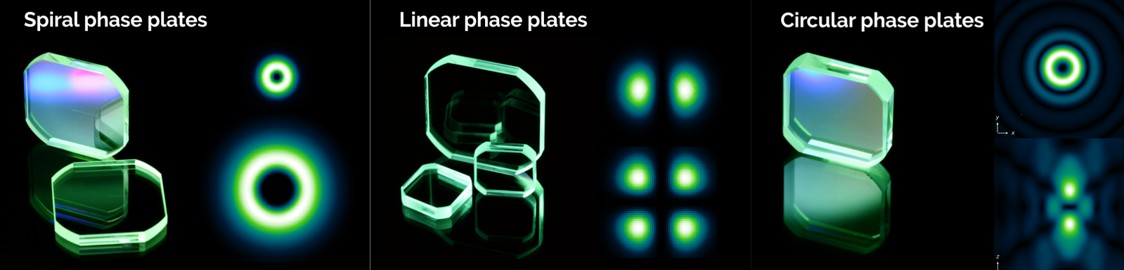
● Vortex Lenses / Spiral Phase Plates
Spiral Phase Plates (SPP) are advanced Diffractive Optical Elements (DOE) that twist a plane Gaussian beam into an optical vortex, offering unique applications. The resulting intensity distribution has a dark central area and therefore called a doughnut-shaped beam. Optical vortices enable higher data transmission rates by employing orbital angular momentum multiplexing and enhance imaging resolution in microscopy. In quantum computing, they allow complex operations by generating high-dimensional quantum states. The laser machining industry benefits from their precision in material processing. Serving as a key technology in optics, Spiral Phase Plates are instrumental in driving innovation and addressing complex challenges across various scientific and industrial domains.
Our spiral phase plates (SPPs) also known as vortex lenses or vortex phase plates are advanced optical elements used to manipulate light in a unique and precise manner, transforming the phase structure of light waves as they pass through. These innovative devices have revolutionized various fields, including microscopy, optical communication, and quantum computing, by enabling the control and generation of optical vortices and beams with orbital angular momentum. Spiral phase plates are designed to impart a helical phase shift to the light waves that travel through them. This special attribute allows SPPs to convert a standard light beam into an optical vortex, characterized by a spiral wavefront and a phase singularity at its core. The ability to generate and manipulate these vortices opens up a plethora of applications in optical manipulation, data transmission, and even in the study of quantum properties of light.
● Phase Steps / Mode Converters
Phase steps or Hermite-Gaussian Mode Converter. Transition from the fundamental TEM00 mode to sophisticated higher-order modes by selectively shifting the phase by a factor π which is the half of the phase. Our user-friendly Mode Converter is designed for professionals in optical research, material processing, medical technologies, and telecommunications, offering a wide range of applications. Whether you're advancing scientific studies, improving material processing accuracy, or developing cutting-edge medical treatments, our Mode Converter paves the way for innovation.
● Circularly shaped phase plates
Circular pi plates or axial phase plates. Shift the phase of the central zone of the beam by a factor π and turn a Gaussian focus into a bottle beam — a z-doughnut with an intensity zero on the optical axis. While the spiral phase plate confines light laterally, the circular pi plate confines it axially, which is why 3D STED microscopy uses both together. Designed for professionals in super-resolution imaging, optical trapping, and laser material processing, and offered with four zone diameters per wavelength so that the plate matches your beam.
What are the circular pi plates?
Our circular pi plates, also known as axial phase plates or z-doughnut phase masks, are two-level diffractive optical elements. The surface carries a single circular phase zone of diameter d, structured into optical grade fused silica. Light passing through the inner zone travels a different optical path than light passing through the surrounding ring, and the depth of the step is chosen so that this path difference corresponds to exactly half a wave, a phase shift of π, at the design wavelength. Unlike a spiral phase plate, a circular pi plate carries no azimuthal structure and therefore imprints no orbital angular momentum on the beam. Its symmetry is purely radial, and so is the effect it has on the focus: instead of a lateral doughnut it produces an axial one.
제품소개
PRODUCTS



- 34071 대전광역시 유성구
지족로 355, 401(지족동, 월드프라자) - Phone : (042) 867-2227
- Fax : (042) 867-2228
- C.P. : 010-3562-5588
- Email : info@skphotonics.com
- Email : yoon@skphotonics.com
Copyright © 2019 SeongKyeong Photonics Co., Ltd. All Rights Reserved.
